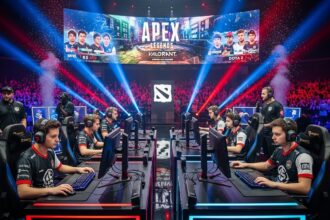

Esports has transcended from a niche hobby into a global cultural and economic force, with millions of fans, players, and industry stakeholders participating in its growth. Today, esports has become a multi-billion dollar industry, integrating competitive gaming into mainstream culture, forging new professional pathways, and even influencing various aspects of entertainment, technology, and social interaction. But how did esports get here, and where is it going? This blog post explores the evolution of esports, its current impact, and what we can expect in the future of competitive gaming.
The Beginnings: A Humble Start
The roots of esports can be traced back to the early days of video games in the 1970s and 1980s. The first known competitive gaming event took place in 1972, with Stanford University hosting the “Intergalactic Spacewar Olympics.” This was a small, collegiate event centered around the game Spacewar, but it set the foundation for competitive gaming as a form of entertainment and skill.
Fast forward to the 1990s, and arcade games like Street Fighter II and Mortal Kombat began to popularize competitive play, though it remained mostly regional and informal. At the same time, the emergence of online multiplayer games such as Quake and Warcraft set the stage for global tournaments.
The late 1990s and early 2000s marked the beginning of organized esports events. The Cyberathlete Professional League (CPL), founded in 1997, was one of the first organizations to host tournaments for games like Quake III Arena and Unreal Tournament. As internet access became more widespread, games transitioned from offline, local competitions to large-scale, global tournaments.
The Rise of Esports: The 2000s to Early 2010s
The 2000s marked a turning point for esports, particularly with the introduction of games like StarCraft and Warcraft III, which helped establish a strong foundation for esports leagues. In South Korea, StarCraft: Brood War became a national phenomenon, with televised tournaments, dedicated TV channels, and even professional players achieving celebrity status. The professionalization of gaming in South Korea was an early model that the rest of the world would follow.
By 2010, esports had expanded beyond Korea, with major international tournaments taking place in Europe and North America. League of Legends (LoL) was released in 2009, and by 2011, it had become a global sensation, with Riot Games introducing the League of Legends World Championship, which would become one of the largest esports events in the world.
As the esports industry grew, sponsorships from major brands, including Coca-Cola, Intel, and Red Bull, began to pour in, signaling that esports was becoming a legitimate form of entertainment. Broadcast platforms like Twitch, which launched in 2011, helped to give esports a global stage, allowing millions of fans to watch live streams of professional players battling it out in real-time.
The Current State of Esports: A Multi-Billion Dollar Industry
Today, esports is not just a subculture; it’s a mainstream industry with an estimated value of $1.5 billion in 2023. The industry includes multiple facets, including professional gaming leagues, sponsorships, streaming platforms, media rights, and merchandise sales. As esports has evolved, so too has its infrastructure.
Professional Leagues and Teams
Esports today boasts a range of professional leagues similar to traditional sports, such as the Overwatch League (OWL), Call of Duty League (CDL), and the League of Legends Championship Series (LCS). These leagues are highly organized, with players contracted by professional teams that operate like traditional sports franchises.
Top-tier esports teams have players from all over the world, many of whom are treated like athletes, with coaches, analysts, and training regimens. Some of the most successful and high-profile esports organizations include Team Liquid, T1, Cloud9, and Fnatic, all of which compete in games like League of Legends, Dota 2, and CS:GO.
Esports leagues have adopted various formats, including city-based competitions (e.g., OWL) and regional leagues (e.g., LoL). In these leagues, players compete for cash prizes, endorsements, and the opportunity to represent their teams on the global stage.
Sponsorship and Investment
Sponsorship has been a major contributor to the growth of esports. Companies are eager to associate themselves with a rapidly growing audience, especially since the target demographic for esports—young, tech-savvy individuals—is highly desirable for advertisers. Major brands like Coca-Cola, Mercedes-Benz, and Audi have invested heavily in esports sponsorships, sponsoring tournaments, teams, and even individual players.
Investment in esports is also booming, with venture capital firms and traditional sports organizations beginning to view esports as a lucrative investment. In 2021, reports revealed that private equity firms were increasingly funding esports teams, leagues, and tournaments. Major tech companies, such as Amazon, Google, and Microsoft, have also shown interest in esports, acquiring streaming platforms like Twitch and launching their own gaming-related services.
Streaming and Viewership
The rise of streaming platforms like Twitch, YouTube Gaming, and Facebook Gaming has been a driving force in the expansion of esports. In 2023, Twitch alone had an average of over 2 million concurrent streamers, many of whom stream esports events, while also interacting with fans in real-time. These platforms have democratized content creation and allowed individuals to build personal brands as esports influencers, further elevating the visibility of esports.
Esports viewership has grown exponentially, with major tournaments now rivaling traditional sports in terms of online viewership. The 2023 League of Legends World Championship, for example, attracted over 100 million unique viewers across the globe. Major tournaments such as The International (for Dota 2) and the CS:GO Major Championship also attract millions of viewers each year, further cementing esports as a dominant global entertainment medium.
Esports as a Social Phenomenon
Esports has had a profound impact on social interactions, creating a new kind of community where fans, players, and streamers can interact and form bonds. The esports community is a global one, with players from different parts of the world coming together to compete in tournaments or simply share their passion for gaming.
Platforms like Discord and Reddit have created spaces for fans to discuss strategies, share memes, or engage in fan theories about upcoming tournaments. This sense of community has given rise to “fan culture” around esports, where fans form deep emotional connections with teams and players, similar to how traditional sports fans feel about their favorite teams.
The Intersection of Esports and Traditional Sports
One of the most fascinating trends in esports is the growing crossover with traditional sports. Esports teams are increasingly being managed like traditional sports teams, with professional coaching, player development, and even salary structures. In fact, some traditional sports teams are investing in esports as a way to expand their brand and reach younger audiences.
For example, teams from the NBA (like the Milwaukee Bucks and Golden State Warriors) and major soccer clubs (such as Manchester City and Paris Saint-Germain) have entered the esports arena by creating their own teams or sponsoring existing ones. This has led to increased legitimacy and recognition for esports, aligning it with traditional sports in the eyes of the public.
There are also growing efforts to make esports more “official.” Some countries have even begun to classify esports as a legitimate sport, granting players and coaches official recognition and providing them with opportunities for government-backed training and funding. South Korea, for example, has been a pioneer in creating professional esports infrastructure, with esports stadiums and government support for players.
The Future of Esports: What’s Next?
Esports in Education
As esports continues to grow, educational institutions are beginning to embrace competitive gaming. Schools and universities around the world are offering esports scholarships and building state-of-the-art gaming arenas. Esports programs are also being integrated into physical education curricula, with students training in gaming skills alongside traditional sports.
The rise of esports degrees and certification programs indicates that the next generation of players, coaches, broadcasters, and analysts will be highly educated in their craft. Educational institutions are positioning themselves to provide the workforce for a booming industry, and with the rise of esports, students are now able to make careers out of gaming in a way that was unimaginable a few decades ago.
Virtual Reality and Augmented Reality
The future of esports is not limited to traditional games; it is also branching into new forms of immersive experiences, such as Virtual Reality (VR) and Augmented Reality (AR). While VR and AR are still in their infancy, both technologies have the potential to change the landscape of competitive gaming.
Imagine esports tournaments where players compete in a fully immersive VR world, experiencing the action from a first-person perspective, or where fans can use AR to get real-time stats and highlights during a live event. These technological advancements have the potential to add an entirely new layer to the esports experience.
Esports and AI
The integration of Artificial Intelligence (AI) into esports could also open up new possibilities. AI could be used to enhance gameplay experiences, help with game balancing, or even create new types of virtual opponents for training. Moreover, AI could be employed in analyzing player data to improve team strategies, much like how data analytics is used in traditional sports.
Global Expansion
One of the most exciting aspects of esports is its global appeal. While esports has primarily been popular in countries like South Korea, China, and the United States, its popularity is spreading rapidly in other parts of the world, including Southeast Asia, South America, and the Middle East. With an increasing number of international tournaments, local leagues, and grassroots movements, esports is poised to continue its rapid growth across the globe.